Natasha Green

Why a Cup of Beans a Day Could Boost Your Heart Health

Introduction:
Could something as simple as adding beans to your daily meals improve your heart health? According to new research presented at the American Society for Nutrition’s annual meeting, the answer is yes. A recent study shows that eating just one cup of beans each day can deliver measurable benefits for heart and metabolic health—especially for those at risk of chronic conditions like heart disease and type 2 diabetes.

Body:
The 12-week study followed 72 adults with prediabetes, a group often dealing with impaired lipid metabolism and chronic low-grade inflammation. Participants were randomly assigned to eat either black beans, chickpeas, or rice (as a control) daily. The results were striking:

  • Chickpea eaters saw their total cholesterol drop from an average of 200.4 mg/dL to 185.8 mg/dL.
  • Those eating black beans experienced a significant reduction in inflammation markers, with interleukin-6 levels falling from 2.57 to 1.88 pg/mL.

While blood glucose levels remained unchanged, these improvements in cholesterol and inflammation are critical for reducing the risk of heart disease and diabetes.

Why Beans Work:
Beans are nutrient-dense, high in fiber, and packed with plant-based protein. They also support gut health, which plays a role in inflammation and metabolic processes. Best of all, they’re affordable and easy to incorporate into everyday meals.

Takeaway:
Adding a cup of beans—whether black beans, chickpeas, or other varieties—to your daily diet could be a simple, cost-effective strategy for better heart health. It’s a small change with big potential benefits.

Call to Action:
Ready to give it a try? Start by swapping your usual side dish for a hearty bean salad or adding beans to soups and stews. Your heart will thank you!

Check out the original article here: https://www.news-medical.net/news/20250603/Daily-bean-consumption-linked-to-improved-heart-and-metabolic-health.aspx

Reducing Ultra-Processed Foods: Why It Matters and How It Works

Ultra-processed foods (UPFs) make up nearly 60% of the American diet. While convenient, these foods are linked to obesity, diabetes, cardiovascular disease, depression, and even increased mortality. So, how do we break free from this cycle?

A recent pilot study published in Obesity Science & Practice explored whether a structured behavioral program could help people significantly reduce UPF intake. The findings offer hope—and practical strategies—for anyone looking to improve their health.


What Was the Goal?

The study aimed to test the feasibility, acceptability, and preliminary effectiveness of an 8-week intervention designed to cut back on UPFs. Researchers wanted to know: Can people realistically make this change, and what support do they need?


The Intervention

Participants joined an 8-week program that combined:

  • Education on identifying UPFs and understanding their health risks.
  • Meal planning and financial support to make healthier choices accessible.
  • Acceptance-based strategies (from ACT therapy) to manage cravings and withdrawal symptoms.
  • Household involvement to create a supportive home environment.

This wasn’t about strict dieting—it was about building sustainable habits.


The Results

The outcomes were impressive:

  • UPF calories dropped by 48.9%.
  • Sugar intake fell by 50%, and sodium by 37%.
  • Participants lost an average of 3.5 kg in just eight weeks.
  • While fruit and vegetable intake didn’t change significantly, the overall diet quality improved.

Most importantly, participants rated the program as highly feasible and valuable, showing that meaningful change is possible with the right tools.


5 Tips to Reduce Ultra-Processed Foods Today

  1. Read Labels Carefully
    Look for short ingredient lists and avoid products with additives, artificial flavors, or preservatives.
  2. Cook More at Home
    Preparing meals from whole ingredients gives you control over what goes into your food.
  3. Swap Snacks
    Replace chips and packaged sweets with nuts, fresh fruit, or yogurt.
  4. Plan Ahead
    Meal planning reduces the temptation to grab convenience foods when you’re busy.
  5. Start Small
    Focus on reducing one category at a time—like sugary drinks—before tackling everything at once.

Why This Matters

Reducing UPFs isn’t just a personal health choice—it’s a public health priority. Behavioral interventions like this can empower individuals, but broader policy changes are needed to make healthy eating the norm.


Want to dive deeper into the research?
Read the full study here: https://onlinelibrary.wiley.com/doi/10.1002/osp4.70029

Reclaiming Wellness in Later Life: What the Data Tells Us

Can older adults bounce back from poor health and well-being?
A new study published in PLOS ONE says yes—and the findings are both hopeful and actionable for those working in geriatric care.

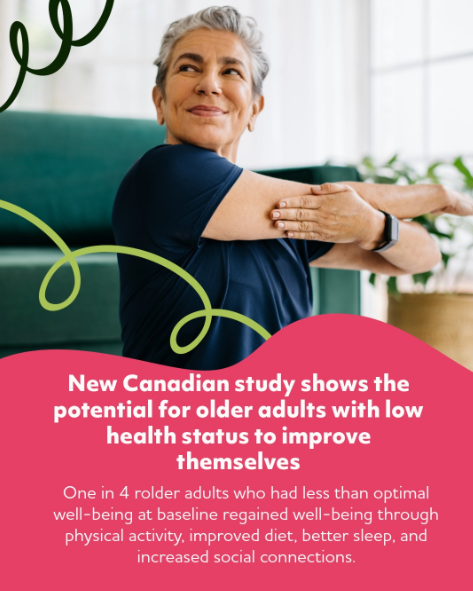
Researchers analyzed data from over 8,000 older adults in the Canadian Longitudinal Study on Aging (CLSA) who were not in optimal well-being at the start of the study. Three years later, nearly one in four had regained a state of optimal well-being. That’s a powerful reminder: aging doesn’t have to mean inevitable decline.

🔍 What Is “Optimal Well-Being”?

In this study, optimal well-being meant more than just the absence of disease. It included:

  • Adequate social support
  • Positive self-perception of aging
  • Good physical and mental health
  • Freedom from disabling pain, cognitive decline, or limitations in daily activities

🧠 Key Factors That Helped Older Adults Reclaim Wellness

The study found that individuals who were:

  • Younger (within the 60+ cohort)
  • Married
  • Physically active
  • Non-smokers
  • Not obese
  • Free from chronic conditions like diabetes, arthritis, and osteoporosis
  • Financially stable
  • Without sleep problems

…were significantly more likely to regain optimal well-being. Importantly, those who had strengths in at least two of the four wellness domains—physical, psychological/emotional, social, and self-rated wellness—had better outcomes. [journals.plos.org]

💬 Why This Matters for Geriatric Care

This research challenges the narrative that aging is a one-way street toward decline. It shows that wellness is dynamic, and with the right supports, older adults can recover and thrive—even after setbacks.

For geriatric professionals, caregivers, and policy advocates, this means:

  • Investing in programs that promote physical activity and social connection
  • Screening for sleep issues and mental health concerns
  • Supporting lifestyle changes that reduce chronic disease risk
  • Creating environments that foster purpose and self-worth in aging

🌟 Dakota Geriatrics Takeaway

At Dakota Geriatrics, we believe in the resilience of older adults. This study reinforces our commitment to holistic, person-centered care that sees aging as a journey—not a destination.

Let’s continue to build systems that help older adults not just live longer—but live well.

Richardton Health Center Achieves IHI Level 1 Age-Friendly Health System Participant Status

We are proud to announce that Richardton Health Center, located in Richardton, North Dakota, has achieved Level 1 Age-Friendly Health System Participant status, as recognized by the Institute for Healthcare Improvement (IHI). This milestone reflects the center’s commitment to delivering high-quality, person-centered care to older adults.

🌟What Is an Age-Friendly Health System?

The Age-Friendly Health Systems initiative is built around the evidence-based 4Ms Framework, which ensures that care for older adults is not only safe and effective but also aligned with what matters most to them:

  • What Matters: Understanding and honoring each older adult’s health goals and care preferences.
  • Mentation: Supporting cognitive health and addressing conditions like dementia, depression, and delirium.
  • Medications: Using age-appropriate medications that do not interfere with the other 4Ms.
  • Mobility: Encouraging safe movement to maintain function and independence.

With the support of Dakota Geriatrics, Richardton Health Center has successfully integrated these principles into its care model.

💬A Commitment to Older Adults

By focusing on what truly matters to each individual, supporting mental and cognitive health, managing medications wisely, and promoting mobility, Richardton Health Center is setting a high standard for age-friendly care in rural communities.

 🏆Leadership Recognition: Mandy Robinson Receives Eli Pick Award

We are also thrilled to share that Mandy Robinson, Administrator of Richardton Health Center, has been honored with the prestigious Eli Pick Facility Leadership Award. This award, presented by the American College of Health Care Administrators (ACHCA), recognizes administrators whose leadership has contributed to superior facility performance.

👉 Learn more about the Eli Pick Award here.

🎉 Congratulations!

We extend our heartfelt congratulations to the entire team at Richardton Health Center and to Mandy Robinson for their dedication and leadership in advancing the health and well-being of older adults in our community.

Home Therapy Solutions receives certification as Age Friendly Health Care System

Home Therapy Solutions Achieves IHI Level 2 Age-Friendly Health System Committed to Care Excellence Status!

The Grand Forks business has met requirements and standards, qualifying that its services for older adults ensure they are aging in the right place!

We are proud to announce that Home Therapy Solutions LLC in Grand Forks, North Dakota, has achieved Institute for Healthcare Improvement (IHI), Level 2 Age-Friendly Health System Committed to Care Excellence status. This significant accomplishment recognized by IHI, highlights Home Therapy Solutions’ dedication to improving care for older adults.

The Age-Friendly Health Systems initiative is centered around the “4Ms” framework, which ensures that the care provided to older adults is comprehensive and tailored to their unique needs. The 4Ms are:

  1. What Matters: Prioritizing each older adult’s health goals and care preferences.
  2. Mentation: Focusing on maintaining and improving cognitive function and addressing mental health concerns.
  3. Medications: Ensuring that medications are age-appropriate and do not interfere with the other aspects of the 4Ms.
  4. Mobility: Promoting safe mobility to help older adults maintain their independence and function.

With the support of Dakota Geriatrics, Home Therapy Solutions has been successful in implementing these principles, ensuring that older adults receive respectful, individualized, and holistic care. By focusing on what truly matters to each person, supporting cognitive health, managing medications wisely, and encouraging mobility, Home Therapy Solutions is setting a new standard for age-friendly care.

We congratulate Home Therapy Solutions on this achievement and look forward to continuing our partnership to improve the lives of older adults in our community.

See their announcement in the Grand Forks Herald!